The idea started innocently enough.
I was sitting at a regional TFA workshop listening to a debate about answer validation standards when someone casually mentioned that some of the best trivia experiences in the country weren't happening in breweries or conference centers.
They were happening at drag shows.
The statement lingered in my mind.
As a TFA-certified administrator, I've spent years obsessing over fairness, question construction, appeals, and scoring systems. I've attended conventions where people argued about acceptable abbreviations for forty-five minutes. I've reviewed appeals longer than some graduate theses.
Yet somehow I'd never really explored the world of drag trivia.
So I decided to fix that.
Over the course of several weeks, I traveled across the country with a notebook, a suitcase, and what I believed to be a healthy appreciation for pop culture.
What I did not realize was that by the end of the trip I would become trapped in an endless cycle of Lady Gaga questions and increasingly exhausted performances of Lizzo's Good as Hell.
The first stop was New York.
Walking into Albatross Bar in Queens felt less like entering a trivia event and more like arriving at a party that had somehow evolved into a competitive knowledge tournament.
The room was loud.
Teams were already debating answers before questions had been asked.
People knew one another.
The host moved effortlessly between stand-up comedy, crowd work, and trivia administration.
As a TFA administrator, I found myself admiring the balancing act.
Getting a room full of competitive players to laugh together is much harder than most people realize.
The questions were surprisingly good.
Broadway.
History.
Television.
Music.
Then came a question about Lady Gaga.
The crowd erupted.
Not applauded.
Not cheered.
Erupted.
Several teams reacted as though they had spent years preparing specifically for this moment.
One player actually stood up.
I laughed.
It was fun.
I made a note in my notebook:
New Yorkers seem unusually enthusiastic about Lady Gaga.
At the time I assumed this observation would remain specific to New York.
It did not.
A few nights later I found myself at Lips in Manhattan.
The production value was extraordinary.
The performers were polished.
The audience was engaged.
The entire event felt like it had been rehearsed to perfection.
About halfway through the evening I experienced a strange sensation.
The questions sounded familiar.
Madonna.
Lady Gaga.
Madonna again.
Lady Gaga again.
A tie-breaker involving Madonna.
I began flipping through my notes from earlier in the week.
Surely I was imagining things.
Surely there was more variety than I remembered.
There was not.
By the time I arrived in Chicago, I had developed what can only be described as a professional curiosity.
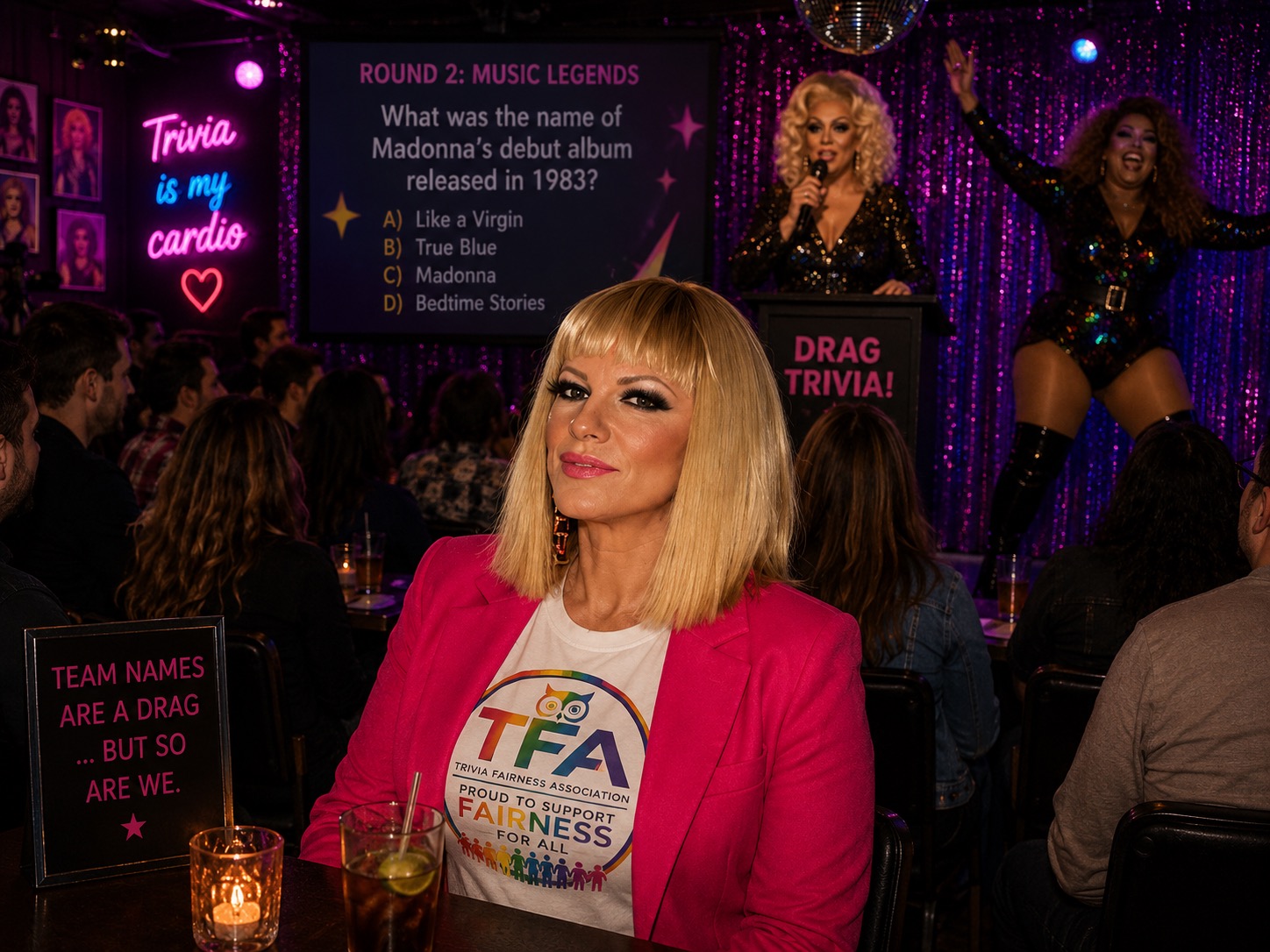
At Hamburger Mary's I decided to conduct an experiment.
Before the music category began, I wrote three predictions in my notebook.
1. There will be a Lady Gaga question.
2. There will be a Madonna question.
3. Someone will reference RuPaul's Drag Race.
I then sat back and waited.
The category began.
The first question involved Madonna.
The second involved Lady Gaga.
The third involved RuPaul's Drag Race.
I stared at my notebook for a long time.
I wasn't upset.
I was impressed.
The statistical consistency was remarkable.
Meanwhile another pattern had begun to emerge.
A musical pattern.
A deeply troubling musical pattern.
The first time I heard Lizzo's Good as Hell performed during a drag trivia event, it was fantastic.
The crowd loved it.
The performer owned the room.
People danced.
People sang along.
It was a highlight of the evening.
The second performance, in a different city, was also enjoyable.
The third felt familiar.
The fourth felt suspicious.
By the fifth performance I had started wondering if there was some kind of federal requirement.
Every city.
Every venue.
Every region.
At some point during the evening somebody would announce:
"And now here's Lizzo!"
The audience would cheer.
The opening notes would begin.
And I would quietly write another tally mark in my notebook.
The performances themselves somehow became progressively stranger.
One performer forgot several verses.
Another spent nearly three minutes trying to find the correct audio file.
At one venue the performer seemed genuinely surprised when the song started playing, as though they had forgotten what number they were about to perform.
The low point occurred somewhere in the Midwest.
The performer appeared exhausted.
The audience appeared exhausted.
Even the song seemed exhausted.
Yet somehow everyone persevered.
By Milwaukee I had become obsessed.
Not with the performances.
Not with the trivia.
With the patterns.
I started predicting categories before they appeared.
I started predicting answers before questions were asked.
I became the kind of person who walks into a venue and immediately thinks:
There's going to be a Madonna question tonight.
And I was almost always right.
The more venues I visited, the more fascinated I became.
The hosts were different.
The crowds were different.
The cities were different.
Yet somehow they all seemed connected by an invisible thread of Lady Gaga, Madonna, and increasingly weary renditions of Good as Hell.
And yet despite all of this, something remarkable happened.
I kept having a wonderful time.
Every city felt different.
Every audience brought its own energy.
People celebrated each other's victories.
Strangers became teammates.
Competitive players cheered for newcomers.
The atmosphere was welcoming in a way that many traditional trivia events struggle to achieve.
I found myself staying after games to talk with hosts.
I listened to stories about communities that had formed around these events.
Friendships.
Relationships.
Regulars who had been attending for years.
The trivia wasn't always perfect.
The categories sometimes repeated.
The music choices occasionally felt trapped in a time loop.
But the sense of community was undeniable.
By the end of the trip I realized I wasn't going to remember the Madonna questions.
I wasn't going to remember the exact Lady Gaga categories.
I probably wasn't even going to remember which performance of Good as Hell was the most aggressively mediocre.
What I would remember were the people.
The laughter.
The energy.
The feeling that everyone in the room was participating in something joyful.
Still, if any drag trivia hosts are reading this, I do have one professional recommendation.
There are, in fact, other musicians.
I have checked.